I don’t believe I live in a country where Muslims are seen as ordinary human beings. It’s nearly impossible for the media to have a serious discussion of Islam in America; when they try, they’re seen as “sympathizers.” Journalists with bigoted views toward Muslims are allowed to say whatever they want with impunity; just look at Bill O’Reilly, Marty Peretz, the cast of Fox News. And it’s only gotten worse since this summer, when the media machine lost its mind and decided that Pamela Geller was a reliable source, thereby catapulting the otherwise fairly-unknown “issue” of Park51 into the mainstream.
That’s why I was fairly surprised when, last night, NPR fired commentator Juan Williams, for bigoted anti-Muslim remarks made during an appearance on Fox News. Before delving into a discussion of whether or not NPR’s decision was justified, let’s examine what Williams said:
I mean, look, Bill, I’m not a bigot. You know the kind of books I’ve written about the civil rights movement in this country. But when I get on a plane, I got to tell you, if I see people who are in Muslim garb and I think, you know, they are identifying themselves first and foremost as Muslims, I get worried. I get nervous.
The first question is whether or not Williams’s comments were bigoted. I would argue that yes, they were. Surprisingly, I agree with Andrew Sullivan’s assessment:
What percentage of traditionally garbed Muslims — I assume wearing a covered veil or some other indicator and being of darker skin — have committed acts of terror? . . . The literal defense of anti-Muslim bigotry on Fox is becoming endemic. It’s disgusting.
What Williams has done is equate religiosity with terrorism which, as Sullivan describes, is the very definition of bigotry. As Glenn Greenwald points out, Williams’s comments were “suffused with falsehoods, not facts.” Every single Muslim who has thus far committed an act of terror on an airplane was wearing Western clothing, not “Muslim garb.” And wearing traditional clothing does not necessarily imply putting one’s religion before other identifiers – hijab, for example, is (though there’s certainly plenty of debate around this point) prescribed by Islam, therefore, it seeks to reason that anyone wearing it is simply fulfilling their religious duty. A Muslim woman wearing hijab is just as normal as a Jew refusing pork: a part of the religion, not the be-all, end-all. Not the foremost identifier.
To those defending Williams’s comments, I also wonder where they draw the line. One person argued to me that this was “different from racism,” because “Muslims choose their religion.” I would beg to differ; the racialization of Muslims is an important concept to understand. It’s why Arab Christians and Sikhs suffer the same treatment in airports as Muslims. You can’t simply justify that by calling it “fear.”
I also have to wonder what would have been the reaction if a commentator had said they fear for their children in the presence of priests, or that they move to the other side of the street when they encounter a black man.
But in the end, was NPR still right to fire Williams, based on that single incident? Greenwald hits the nail on the head:
I’m not someone who believes that journalists should lose their jobs over controversial remarks, especially isolated, one-time comments. But if that’s going to be the prevailing standard, then I want to see it applied equally.
Over the course of the past year, we’ve witnessed the firings of Helen Thomas, Octavia Nasr, and Shirley Sherrod, all of whom were fired for sharing their personal beliefs, however controversial. More recently, Rick Sanchez was fired from CNN for “criticizing his employer,” because of a suggestion that CNN was run by Jews (oddly enough, NPR called it a result of bullying).
The firing of Juan Williams is, in the broader context, justified. Fundamentally, however, should any of these people been fired? A few people, such as journalism professor Jeff Jarvis, have suggested that it would be better to talk it out:
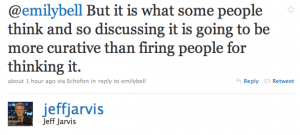 Jarvis unfortunately wouldn’t answer my question as to whether or not he held the same opinion in respect to Thomas, Nasr, or Sanchez.
I think that’s a question worth asking: Would it have been better to have an honest discussion of the origins of Israel than firing the White House’s oldest correspondent? Would it have been better to talk about why some people have respect for Mohammed Hussein Fadlallah? Would it have been better to have a real conversation about whether or not Jews today are a persecuted minority?
Frankly, I would answer yes to every one of these questions. Fundamentally, I don’t believe that firing Thomas, Nasr, or Sanchez was the right move (nor Sherrod, of course, but let’s stick to journalists for the purpose of this discussion). It most certainly would have been better to hold honest discussions on tricky subjects, but every time, for fear of offense, there has been refusal to do so.
At the same time, I don’t believe for a second that we can have a productive conversation about the American fear of Muslims in this country, let alone one lead by anyone at Fox News. Judging by Williams’s comments, I don’t believe he’s ever spent much time with Muslims, and I’m positive that O’Reilly hasn’t. Even the more sensible of American television commentators, Christiane Amanpour and Diane Sawyer, have been criticized heavily for their recent framing of discussions about Islam in America from both sides of the line. Many people saw Amanpour’s framing of the question (“should Americans fear Islam?”) as feeding into the hands of the Right, while those on the Right saw her handling of the debate as biased in favor of Muslims.
So where do we go from here? How can we have a reasonable discussion about Islam and Muslims in America when so many Americans are unwilling to admit that Islamophobia is not so different from racism? More importantly, how can we foster better understanding when so many Americans are unwilling to open their minds?
21 replies on “Did firing Juan Williams shut down a conversation about Muslims in America?”
[…] This post was mentioned on Twitter by Jillian C. York, Oxblood Ruffin and HSofia, Amjad Darwish. Amjad Darwish said: RT @jilliancyork: New blog post: Did firing Juan Williams shut down a conversation about Muslims in America? http://bit.ly/aJCQVr (jilli … […]
Sorry for not responding earlier on Twitter; I got busy.
I think that firing people for what they say once carries the risk we are learning now in all these cases — especially given the speed of the web; the speed of the firings is also becoming more immediate. People say stupid things. Should that always get them fired immediately, too fast for appeal or reconsideration or discussion and lessons?
You asked me the direct question about those cases. This part will come off as a copout but it’s true: I think Helen Thomas has been ridiculous for decades. She has long been, uh, non sequitorial. So I would have found a way to encourage her to move on many years ago.
Now the more direct answer: Would I have fired those people for what they said immediately? No. As I said in the further exchange with my friend Emily Bell, I listen to her and her former colleagues on the Guardian’s MediaTalk and their reflex — common, it seems, in the UK — is off with their heads when someone does something wrong. I don’t buy that.
A different example: Randy Michaels should have been fired LONG ago for screwing up Tribune Company in many ways. The fact that there wasn’t open consideration of firing him until his allegedly sexist stunt in a bar was revealed by the NYTimes only reveals the bankruptcy, in all ways, of the management above him.
I’ve had bad employees. But I learned that if I let them be bad, in any definition, again and again and again, then the last again became my fault. So I wouldn’t have fired Helen Thomas for what she said the last time. I’d have hoped I’d have had the management skills to recognize and deal with her as a problem much earlier.
And in any case, we agree that beheading is not as beneficial as discussion. Lessons beat revenge, eh?
This is the second time I’ve seen the liberal yo-yos take off on Juan Williams when he has “overstepped” his bounds and spoken a truth that was against the “party line”.
I have said more than once in the past that a government run co-opted media is but one step towards the Soviet style dictatorship that we witnessed with the old USSR. This is beyond Big Brother. This is not only the squashing of Free Speech, but is in fact taking away one of our most sacred rights. And he wasn’t even on an NPR show!
This Political Correctness, which is nothing more than a Gestapo style propaganda issue has to stop!
I for one do not agree with some of Mr. Williams stands. however, he has never been afraid to call it as he sees it and in this case he was correct! To be fired for relating the truth is beyond everything we hold sacred in this country.
Kudos to Mr. Williams for daring to stand up to the kind of censorship that is so warmly welcome by leftist Soviet and NAZI style governments!
a better analogy for the veil is conservative jewish men wearing hats or conservative jewish women wearing wigs.
in fact the wigs thing is very similar. some believe it is a required religious duty, there are various degrees of strictness and various interpretations, it is mostly talked about in the context of modesty and avoiding inciting sexual reactions. it has also part fashion, wearing it is rarely a statement, you can’t infer much from the fact that some women is wearing a wig. and is plain frigging weird to any outsider (as someone used to hijab I can’t fathom the wig thing, why don’t they just wear a veil?)
I see this as more of a corporate power issue than a diversity of opinion issue. The problem is that the media continues, like most of the rest of American life, to be dominated by giant corporations. In addition, most media jobs, like most other American jobs, are subject to the “employment at will” doctrine, meaning you can be fired for any reason or no reason at all.
The raison d’etre of a corporation, obviously, is to make money. By extension, corporate management would prefer to alienate as few customers as possible. For the media, readers/viewers are customers. In pursuit of profit maximization, corporate media tend to produce mindless pablum (Time/Newsweek), ludicrous sensationalism (National Enquirer), or one-sided political agitation (Fox News). Deviation from the party line that might antagonize the base is punished. This is true not just of the media, but of any large corporation.
Mr. Williams’ remarks were a clear deviation from the NPR “brand,” the more so since he has some cred as the author of books about civil rights. Ditto for Sanchez and Thomas. The theory behind the First Amendment and the American ideal of free speech is often expressed as faith that good speech will cure bad speech if everyone is given an equal right to speak. Too often, however, the marketplace of ideas is crowded out by the plain old marketplace. The problem is twofold. First Juan Williams is elevated to a platform where his ideas have extra impact so long as he retains his corporate backing, and then then he is coerced when his ideas deviate from the party line.
For this reason, I think that decentralization of the media through the Internet, cable television, and other diversified media can have some positive benefits, although I do worry about the loss of institutional resources that allow for rigorous investigation of governments and corporations. Perhaps that is why we need WikiLeaks. And it is certainly why I agree that, much as I detest Mr. Williams’ views, we need to promote more discussion.
The best service intelligent people can render to the noble cause of countering Islamophobia is to examine honesty and accurately the facts surrounding 9-11, which should be viewed as the ‘Origin Myth of the War on Terror’.
9-11 (along with the London 7/7 bombings and other smaller ‘trigger events’) is the great ‘Blood Libel’ of our era.
Until it is debated and reported truthfully, Zionists will continue to ‘frame’ debate about Islam with a highly distorted, anti-Mulsim bias.
Thanks for your response, Jeff. “Non-sequitorial” has got to be the best descriptor I’ve heard for Helen Thomas.
Though I don’t mean to direct this at you (as I don’t know what you said at the time), I’ve noticed that a lot of the people standing up for Williams are not the same people who stood up for Shirley Sherrod or Octavia Nasr. I would imagine you agree with me that their firings, for single incidents, were wrong, but I don’t believe that’s the case across the board, and I find that terribly sad.
In any case, thanks again for sharing your thoughts here.
You know, I’ve heard that there’s quite a bit of disagreement over what’s actually expected of Orthodox Jewish women in terms of how they’re supposed to cover their heads. Some women cover their heads with scarves instead of wigs. I’m not much one for religion, but that’s what I like about Judaism – that there never seems to be one right answer, that everything is up for debate.
In any case, I don’t understand the wig thing either.
Great Post, Jillian. This statement always gets me:
“One person argued to me that this was “different from racism,” because “Muslims choose their religion.”
I’ve heard similar statements about homosexual rights, from those who believe it is a lifestyle “choice” as opposed to a genetic predisposition – as if the act of choosing voids the protection of your rights. It’s a strange idea, and I’m not sure where it comes from, especially considering the culture in the US, where the protection of religious freedoms, and primarily the freedom of choice, has always been a mainstay of our values.
Your response is perfect. The inability for those of us in the West to separate out the ethnic and religious identities of Arabic-speakers, Muslims, or generally “darker-skinned” peoples seems to be our greatest downfall as we attempt to have this incredibly important conversation. I don’t know how I’d feel if NPR had kept Juan Williams around, I never understood that relationship to begin with – but maybe that says more about our expectations of the current state of journalism (drawing their lines in the sand) than anything else.
Peace.
I like the way the discussion is framed here. As Mr Jarvis stated in his twitter update, “it is what some people think”. I believe that the fact that the “some” here is perceived as a substantial group of people, at least substantial enough for Mr Juan Williams to feel comfortable enough to voice it as an opinion that many would agree with. If that was not the case, 1) he would have not said it, 2) there would be not be so many people crying foul over the firing.
The core issue to me is that just because so many people think it is OK to think that way, does not make it OK. We are seeing a clear mainstreaming of bigotry that is not limited to the US but most of Europe and frankly the majority of the region I cover for GV.
I am not sure that by acknowledging the fact that many people now voice their bigotry freely, we are doing society a favor. It feels like a free-for-all for everywhere to lose themselves in their most primal fear. We are supposed to be civilized adults who can show restrain over what the primitive part of our brain.
Whether talking about it will help, I am not sure what kind of conversations will improve things over the short-term. It was supposed to be folks in the center like Mr Williams who could bridge a conversation. The opinion makers who would reinforce over and over that generalization about a religion is bad news every time. It does not help if Maddow or AC say it. We needed Williams to help Shepperd Smith hold the fort of reason at the increasingly crazy-R-us channel. But Williams did not and he compounded his failure by blaming the thought police iinstead of checking himself in the mirror.
[FWIW, not that it matters but I was baptized and I am pretty much agnostic at this point]
Have I told you how much listening to the comment by Juan Williams felt like a kick in the teeth? I’m a “young” black american, I’ve lived with stereotypes and grew up in them. My family is of haitian descent and unlike some of my neighbors we had strict lesson plans all the way through to my high school life.
When Juan said that statement all I can think about is a (white) person clutching their purse when I get on the bus or train. People giving me a second look as I pass them by on the street. And the thing is, even while I’m dressed in a suit and tie, I seem more intimidating because my skin happens to be a darker shade. I can (marginally) imagine how it is to be trapped in your religion, externally, and judged because of that.
I believe that Juan needed correction, not to be fired. That was a hasty decision by NPR, who probably didn’t want to suffer the wrath of the media. Imagine if they didn’t take corrective action? They’d be liable to his comment until they did.
[…] Did firing Juan Williams shut down a conversation about Muslims in America? (jilliancyork.com) […]
+1 – I really appreciated this comment.
@Gorillamonk: I don’t see any connection whatsoever. Being black is genetic. Being Muslim is a choice. I was “born” a Muslim, and when I was old enough to decide for myself, I renounced that silly ideology. It’s that simple!
I understand that, but, it’s still something where you are identified visually. And there’s a stigma for that and a derision wherever you go.
@Gorillamonk: I feel for you…in most places (whether in the USA or elsewhere) people with darker complexions happen to be overrepresented in crime. Hopefully, most people in the modern era can distinguish between correlation and causation. In the case of Islam, the ideology is the cause (the crimes Juan is scared are perpetrated IN THE NAME OF Islam!). Don’t want to stand out in a crowd? How about ditching the hijab or djellabas and embracing universal values instead of ones from 7th century Arabia?
This is the first time in history when the Muslim world stands a chance of reforming itself and joining the rest in a big happy family. Equating criticism of Islam with racism is the least progressive thing one can do. It holds back a much needed reform of Islam.
Ideology is the cause? Are you serious? So, if a person commits a crime, it’s not the person who is responsible for their own actions, it’s the ‘ideology’? What about Muslims who don’t commit crimes? Why do WE not commit crimes?
Also, I don’t think forcing women to expose themselves to YOUR standards of dress is progressive at all. In the USA we pride ourselves on DIVERSITY not UNIFORMITY.
I still don’t understand why ‘former’ Muslims(or in fact any other ex:insertyourformerreligionhere) harbor such ill-will towards an ENTIRE group of people. I have absolutely no bad feelings towards my former faith even though I have been discriminated against by it’s adherents on multiple occasions..
Samira,
Criticism of Islam is not racism. Treatment of Muslims (and non-Muslim Arabs, and Sikhs, and others perceived to be Muslim) is racism. Treating an entire group a particular way based on the actions of a few is racism. The TSA’s latest gag was to send every person from 14 entire countries through secondary security – that list included Syria and Nigeria, two countries with large non-Muslim populations. Do you think that’s remotely acceptable? I don’t.
And people with dark complexions are not “overrepresented in crime” necessarily – there are all sorts of mitigating factors — police discrimination and subversion of the justice system (as well as disparate sentencing laws that target certain communities such as those for powder vs. crack cocaine) among them.
@Rachel
You must have misinterpreted my comment. I was not referring to random crimes but rather the ones committed in the name of Allah to further some jihadist agenda. Those are caused by a certain ideology.
I also like diversity. But when you have adepts of a sexist, Arab-supremicist, totalitarian ideology that threatens freedom of expression as we know it (check out how the UN was lobbied to make criticisms of “prophets” illegal), I don’t see a problem with demanding these people drop their ways and join the rest of humanity with regards to the current universal values.
I have a problem with the political component of Islam. This should be obvious to anyone who knows how liberticidal Islamic countries are.
@Jillian
As a principle, I don’t think it’s acceptable. But that’s business as usual if one accepts the concepts and legitimacy of entities that hinder free movement of people (i.e: countries).
It’s not so much the “actions of a few” that make me suspicious towards a bearded man reciting the Quran. Rather, it’s what is written in his so-called holy book and the actions of his idol – Mohammed.
I am well aware of the mitigating factors with regards to the USA. But I wasn’t specifically referring to that particular country. My assertion holds even in countries that have a majority of “dark” people. Of course, this is not due to some essential trait, but simply because of cultural aspects such as work ethics, etc.
I really don’t believe that just because these so-called Jihadists are comitting crimes in the name of Allah, that they are leading ‘islamic’ lifestyles(heroine addicts and drug dealers in Pakistan/Afghanistan) and are real examples of what a real Muslim is. Could it be that many are using religion as a preface to gain power for their own gains? Also, what about how Muslims are treated in Europe? You disagree with outlawing slurs/insults against ‘prophets’, but how about how ‘dark men of certain religious backgrounds’ have to go through a psychiatrist to get a job? Or how they’re treated in airports. Not all Arab men are sexist pigs! Just like Western men can, too, be sexist and beat their wives/girlfriends. How ironic that even in Morocco, it’s also the religious sector that can be attacked for protesting against the King and the government. Just because a nation has a large majority of Muslims doesn’t mean the oppressors are oppressing in the name of Islam.
Also, Samira, the Bible has things ten times more violent than what is written in the Qur’an. It’s not a book that kills, it’s the person.
@rachel
I think you may be misunderstanding us…the problem is(and you’re reiterating) what a small majority of people do should NOT be the generalization of the mass. But, that’s almost always how it is.
Truly, I believe, the least demonized religion is buddist. And only because their religion centralized itself on one self and singularity. There are no prophets/saints/cultist to point the way to the truth, only another person who realizes the power they have over themselves.
no matter what, rachel. Neither race nor religion can shake what a few have done in negative against what the whole has done in positive.