Luke Allnutt has a thoughtful piece on RFE/RL asking the above question: Would anonymity help activists on Facebook? His response, “maybe not,” relies on the idea that anonymity would be extended only to those with special “activist status,” something I haven’t heard concretely argued as a potential model but which is nonetheless troubling. Allnutt writes:
If Facebook had a special “activist’s status,” where it officially allowed some accounts to be pseudonymous, where does it draw the line? I would assume that as long as they’re not advocating violence or hate speech, then any activist would be entitled to such protection– that would mean Middle East democracy fighters, but also anti-gay groups or guys from the English Defense League. Who gets to choose which activists are acceptable and which aren’t?
and
Connected to the first point is the logistics. How would one prove they are an activist to get a special status? It’s not like activists can fax off their membership cards even if they had them, especially with a move toward more leaderless, loose groupings.
First off, since I’m quoted in his piece, I’ll say this: I have never, and would never, argue for a special status for activists on Facebook. Which bring me to my next point: How we got to the anonymity argument in the first place.
A year ago, as I was beginning to write Policing Content in the Quasi-Public Sphere, I considered, briefly, arguing for anonymity on Facebook but then decided it was a waste of time. Like Allnutt concludes, “Facebook isn’t going to change its real-name policy.” Unfortunately, I’m inclined to agree, and thus have–until recently–made that a low priority in my arguments against the company.
Rather, there are a few other fundamental issues at stake regarding the platform, which I believe would go far in solving a large number of the issues activists face with the real name policy. You’ve heard most of this before, but hear me out:
- Facebook’s Terms of Service are still not available in major world languages. I haven’t done a recent count lately, but last I checked, the platform was available in 100+ languages, but the TOS were only available in 7. A quick check shows that the TOS still aren’t in Arabic or Persian. Again, I will ask: How can someone consent to a set of rules that they can’t read in their native language?
- Facebook offers a limited appeals process that sometimes requires sending in government-issued ID. So, let’s assume for a moment that a person using their real name–like Najat Kessler did–has their account deactivated, erroneously, for using a pseudonym. That person will be, in most cases, asked to send in a government-issued ID. Am I the only one that sees major security risks in doing so? I realize that Facebook is trying to protect against spammers in this instance, but if someone has a well-formed name, with photos of him or herself, I simply don’t understand the harm in taking them for their word. Which brings me to my next point…
- Where’s the appeals process? In a perfect world, someone like Najat Kessler would be able to easily assert her identity when asked, and be taken on her word. But in Kessler’s case, she wasn’t even taken on her ID, which she duly sent in to Facebook after being requested. Her account was never returned to her, despite following the rules.
- The “real name policy” is not evenly enforced. Activists–who often have easy enemies–and semi-famous people are the targets of the policy. Why? Facebook’s TOS are largely peer-enforced, which means that if I don’t like you, all I have to do is report you–or bully a bunch of other people into reporting you–as using a fake name. Your account is then sent into Facebook’s review; sometimes nothing happens, other times, your account is deactivated. The problem here is that your average Santa Claus or Mickey Mouse (see below) is a relative unknown, with no enemies to report him or her, which means that he/she is allowed to remain in the system while folks like Michael Anti–using his widely-known English pen name on the system instead of his lesser-known legal Chinese name–are kicked out.
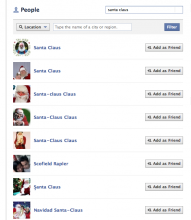
So, is allowing anonymity the solution? Maybe, maybe not. I can honestly say I’d like to see points 1-4 taken care of more than I care about Facebook allowing pseudonyms.
That said, part of the reason I’ve advocated for allowing pseudonyms is that I think the benefit outweighs the harm. Others have argued that opening up Facebook to the anonymous masses makes it less safe; the truth is, the pseudonymous masses are already there. This doesn’t change reality, it only changes policy.
And as Facebook increasingly becomes a part of all of our daily lives, it becomes more and more difficult to tell activists to just “take their content elsewhere.” While it’s true that there are a number of other platforms on which activists can operate anonymously, Facebook is simply where the network is.
18 replies on “Would Anonymity Help Activists on Facebook? A Response to Luke Allnutt”
[…] This post was mentioned on Twitter by Andy Carvin, Jillian C. York, Evgeny Morozov, Luke Allnutt, Robert Guerra and others. Robert Guerra said: RT @jilliancyork: New blog post: Would Anonymity Help Activists on Facebook? A Response to Luke Allnutt http://bit.ly/eBpCOz (jilliancy … […]
Nice post Jillian.
Another thought: While the ability to have an anonymous account might help an activist on an individual basis, with unlimited pseudonyms the Facebook platform as a whole would be less useful for activism. One of the reasons FB is so powerful–especially in closed societies–is that it offers a de facto town square, a virtual civil society. So real people and real groups can assemble and associate on FB despite the restrictions in offline society. But if a substantial number of people on FB acquire anonymous identities, then this network becomes more of a virtually virtual civil society. In short, a social network with weaker ties.
Thank you Duy.
I think you have a very strong point here; to be honest, I’m rethinking the value of anonymity here. On the one hand, as numerous others have pointed out, that’s how most social networks operate, so why should Facebook be the exception?
Despite what some of my critics might posit, I have no real desire to see Facebook overrun with anonymous folks; my primary concern is in protecting the activists in authoritarian regimes who are under threat when they use their real names. It’s actually rather interesting that, in the past couple of months, the number of people under such threat has diminished.
Will think more on this :)
I really think that Facebook is a bankrupt vehicle for activism, and honestly I’m surprised that it is still on the table as a negotiation partner in the matter, so to speak. The company has a proven disinterest in playing this role. They will continue to fumble areas in ways which leave participants vulnerable to long-term surveillance and intimidation. The TOS are broken and obscure — I don’t see how translating them into more languages will fix anything.
And while translating the legal TOS is a nice (utterly meager) symbol of interest in this area, informed consent is not just missing in a legal sense; people are totally missing some of the fundamentals of network security. So my opinion in this matter would be greatly revived if I saw FB investing energy in digital literacy. But in contrast, we know that FB has very privileged Silicon Valley perspective on privacy, and even on a infrastructure level FB did not have any https support until a month ago, a profoundly easy entry route. (Use the Firesheep plugin to a coffeeshop sometime and log into a few people’s email accounts to get a sense of how trivial this kind of espionage is.)
I think that the most important work for activist communications infrastructure is to actually get to work creating alternatives which have these goals specifically in mind, such as Crabgrass. http://crabgrass.riseuplabs.org — no one can spoonfeed these tools for us, because all of it is deeply intertwined with network literacy. We have to all learn along each step of the way how to protect ourselves. The need is for digital literacy, not a “perfectly safe web.”
(By the way the Crabgrass privacy policy and security recommendations are powerful when read against the FB policy [especially if you read the FB policy out loud in a robot voice]: https://help.riseup.net/security/ ).
I have not been a member of Facebook for a couple of years now, so I disagree that it is simply where the network is. I recommend to all of my friends who are invested in improving their countries: please take your self-defense education seriously. Facebook is one of the riskiest hosts for your conversation.
I really think that Facebook is a bankrupt vehicle for activism
So, I largely agree with you on this, but I disagree with you in respect to its importance as the network. You might not be there, but you’re an anecdote in a sea of data – look at the numbers; Facebook holds the market share, so to speak, in the US, the Arab world, and several other places. The average user has 130 friends. That’s a huge reach. Contrast that to Twitter, which has far fewer users on the whole, far less market penetration in authoritarian countries (than any other social networking site, that is), and “following” is made far more difficult (I follow around 1300 people on Twitter, which is about the same number of people I’m friends with on Facebook…but on Facebook, I see everything of importance because of the newsfeed algorithm, whereas Twitter is more a livestream).
The fact is, people are going to go to what they know, what is easy, and where their network is. For the vast majority, that’s Facebook, and the only way that might change is if a genuine competitor emerges.
I say all this while admitting of course that it sucks, and that I agree with you on just about every other point.
If you have no desire to have Facebook overrun by anonymous and Anonymous, Jillian, then you won’t push for anonymous accounts, full stop. And your disclaimer that you aren’t seeking special status for your friends falls apart when we peer at what you *are* asking, which is for them to be able to appeal bannings by pleading that they are important activists who need anonymity.
You don’t want accountability for activists, and you attempt emotional blackmail by playing the card of authoritarian governments’ harassment — as if anyone who doesn’t support your position is somehow wishing identity — and persecution — on an activist. But you’re simply
, discounting the fact that quite a few brave people in authoritarian countries do step up with their real identity and go on Facebook, too. And as I’ve repeatedly noted, people welcome the accountability on Facebook because they can see who they are friending and who they are going into groups and having discussions with, and it helps mitigate the secret police manipulation that happens with anonymity.
You don’t want accountability — and yet you want maximum visibility. You don’t want responsibility — but you want marketshare. That’s simply hypocritical. Visibility has to come with accountability and identity when it becomes that large — do you *really* think that somebody who is using a nickname can lead a revolution in a public square, and keep a nickname on Facebook and attract tens of thousands of viewers — and never have to explain who he is, where he comes from, and what he is about?! Why should activists get to be manpulative that way, just because they live in repressive countries? It’s more than a little disconcerting, their demand to have the same kind of impunity that the governments they’re trying to topple have.
As I’ve noted, I believe Facebook should be left to be the commercial, mainstream platform for the town square, such as it is, given considerable limitations in the TOS and tools that hamper democracy and free expression in other ways. FBI has to be supplemented with all kinds of other things, of course. If you don’t like the lack of security for anonymity, you have other options on the Internet. Yes, Facebook is the paramount social network and increasingly is being used as a log-on to other sites — and that’s a good thing, for establishing accountability and linking reputations to speech online, if there is choice, i.e. Disqus or other services or Twitter which doesn’t insist on real identity. And that’s a good thing, and if you need to conspire and plot to overthrow regimes — no matter how deserving that cause! — don’t expect the world to conform to your conspiracy.
You already have Twitter where secret police manipulation is rampant and where it can be hard to ascertain authentic activists, Twitter is very easily linked to Live Blog or other sites for photos and text, why the demand to overthrow Facebook?
As for Chris Blow’s remarks, this comes from the sort of hard left technologista approach to the Internet that tells us “code is law” and “information wants to be free” and all the rest of it. Dave Winer said at Personal Democracy Forum some weeks ago that “journalism in the cloud” is now “impossible” to keep free “because of Amazon” refusing to host stolen classified government documents. Oh, please. What an infantile exageration. Loads of blogging and journalism routing right past him with silly notions like that. I view Chris’ comments in the same vein. Will we be hearing that Facebook is “bourgeois” in a minute and that the millions playing Farmville have “false consciousness”?
I’d be happy if “progressives” isolated themselves in various Leninist sandboxes in this fashion, away from the corporations and governments and ordinary mass users they loathe and distrust and even hate, and…see who shows up. See if you really attract any reasonable audience. See if you can get the thing paid for. I would imagine you wouldn’t, in any significant, large numbers, just like Indymedia.org never got more than a small sectarian following in most countries, and just like WikiLeaks, even with seemingly more than a 100,000 followers on Facebook, does not enjoy massive respect. Which is why the hard left keeps trying to burrow into other more moderate structures.
No social movement is monolithic. Even in very repressive countries there are people who are public on Facebook and Twitter and people who are not. It’s important movements be diverse and have high and low levels of involvement and risk. You don’t encourage the civil society that must ultimately come from the use of the Internet by anonymity and darknets. But that’s ok, maybe it’s better if you self-discredit in that fashion.
You want so badly for me to fit into this little box of people that you hate, that you are only able to see some of what I write, huh?
I wrote that any user should have a right to appeal a decision. I did not say that anonymous users should have the right to keep their account (assuming the “real name” rule remains, that is). I said that users are often (this is true) erroneously deleted while using a real name, and that there is not a structured appeals process in those situations. Happened last week to a friend.
I wrote that the terms of service are not in Arabic, and that a Facebook user who speaks only Arabic and not English (or another of the 7 languages FB has bothered to translate the TOS to) cannot consent.
Did you bother to read either of those bits or do you prefer to rail on and on about Anonymous? Part of my consideration of this question came from your insipid ranting on the subject, but I’ve proved my point: You are not here to have a discussion, or even to change my mind (which, if you’d bothered to read this post, I may have done). You are here solely to harass. Glad we cleared that up.
For the record, Farmville is totally false consciousness.
@ Catherine Fitzpatrick, I’ve never read so much non-sense since Mein Kampf, you sure rant a lot.
“Visibility has to come with accountability and identity when it becomes that large” You should take a job for the tabloids, I hear they are really good at intruding in people’s personal lives.
On another note, my facebook was disabled one time because they assumed I was using a fake name, ironically they reactivated it when I provided them with an actual fake name AFTER they removed my real name.
http://en.wikipedia.org/wiki/Catherine_A._Fitzpatrick
That explains a lot.
I was an activist on Facebook for 4 years and even used a pseudonym that my friends recognised as such, there was no intent to deceive, it was merely a fun name.
I also used this account as part of my more general professional network. In that time I accumulated contacts from most political parties and many social movements in my country and many professional contacts. I helped organise a protest and was involved in many political discussions. The account had never been disabled before, but then a month ago, it was, without warning. And I was asked for government issued ID, which I don’t have.
None of my contacts, most who also use pseudonyms, have ever experienced that before.
I live in a western country. I am now unable to contact my friends and am losing work, I also have no copy of my data.
I’ve just googled this issue and I’ve seen people from the US, UK and other countries be asked for ID. Some of them appear to be progressively inclined bloggers as well.
I also heard that last year females were ‘accidentally’ experiencing this problem due to a bug that got fixed. My account listed me as a male. Also, that ‘bug’ was six months ago.
So I think Facebook is already censoring activists, and not just members of “Anonymous”.
[…] sur les responsabilités des entreprises qui entreprennent des affaires dans le monde entier (Jillian York rappelle que les conditions d’utilisation de Facebook sont actuellement disponibl…) : les termes des conditions de services étant d’autant plus importants quand les données […]
[…] useful for a people they are perplexing to help. (Though we can’t assistance observant that Facebook can do a lot some-more to make itself a improved platform for open […]
[…] York, a researcher on privacy and censorship with Harvard’s Berkman Center, has written critically about Facebook’s real name policy, an issue Google has addressed through differentiating anonymity from psuedonimity. […]
I don’t leave a response, however after reading a few of the comments here
Would Anonymity Help Activists on Facebook?
A Response to Luke Allnutt | Jillian C. York.
I actually do have 2 questions for you if it’s okay.
Could it be only me or does it look like a few of the responses appear like they are written by brain dead individuals?
:-P And, if you are posting on other online social sites, I’d like to follow
anything fresh you have to post. Could you make a list of all of all your social pages like your Facebook page, twitter feed,
or linkedin profile?
It’s hard to find experienced people for this subject, but
you seem like you know what you’re talking about! Thanks
Amazing! Its really remarkable post, I have
got much clear idea about from this article.
Apart from controlling the diet, you will also need the involvement of proper
sports. Get rid of and throw away all those snacks that are full of sugars
and fats. Shedding weight also means that you are going to need to get some type of
exercise and every single day for the best results.
When used effectively the elliptical can be a great
addition to your pre-existing exercise routine.