In early February, Bahrain–like numerous countries in the region–caught revolution fever. Protesters took over the Pearl Roundabout in the capital, Manama, demanding reform, from February 14 to 17 until, on the last day, police stormed the Roundabout, killing seven and clearing the scene. Still, the protesters returned again and again. On March 3, clashes between the government and protesters (which media reported as sectarian, between the Sunni minority and Shi’a majority), furthered tensions. Just a few weeks later, Saudi troops entered the country, and the Roundabout monument–an icon in Bahrain–was dismantled.
As the street protests have died down–or rather, have been stifled–clashes have moved into the online space, with opposition and regime loyalists vying for the media’s attention. The opposition has been largely successful in using digital tools to get the attention of human rights organizations, as well as journalists. One journalist to take note early on was the New York Times‘ Nick Kristof who, after tweeting his experiences from the ground in Bahrain, was bombarded with tweets from Bahrainis who opposed the protests. Thus began a Twitter war.
I’ve watched journalists such as the Voice of America’s Cecily Hilleary and my good friend Amira Hussaini (who wrote about her experience here) fall victim to the Twitter regime loyalists.
Last weekend, I became the latest victim of the Bahraini Twitter war after I came across some tweets which claimed that I was behind a website called “Human Rights for Bahrain.” As it turned out, the website had copied and pasted several of my articles from Global Voices, about Bahraini bloggers who had been detained, causing people to believe I was the force behind the entire site (I assure you, I’m not).
Truthfully, I’ve been largely quiet on Bahrain. I tweet the occasional article, and I retweet friends in the country whom I trust, but the truth is, I simply don’t know or understand enough of Bahrain’s politics to be truly involved. And yet, as an advocate for human rights and free expression, I can’t remain quiet as journalists and bloggers are silenced for speaking out.
In any case, last Sunday, I was targeted by one Bahraini who decided to start a campaign to “educate” me about “the real situation in Bahrain.” Within a few minutes, I was bombarded with tweets, many from people who assumed that I supported the Bahraini opposition or that I was in fact behind the aforementioned website. While the woman who started the campaign remained polite, not everyone did. By the end of the day, I had over one hundred and fifty new followers, the majority in Bahrain.
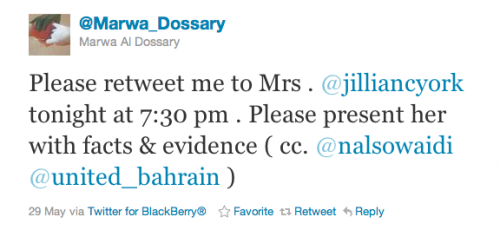
As I’ve learned, I’m not even close to being the only target. These regime loyalists (frankly, for lack of a better term) are also targeting human rights groups on Twitter, as well as fellow Bahrainis who support the protests or who at some level have spoken up against the ongoing detentions of journalists and doctors. One friend in the country tells me that the majority of the individuals targeting me on Twitter appear to be part of the royal family or otherwise associated with the government. That same friend also says, “It’s not really about Sunni or Shi’a, it’s about maintaining the status quo.”
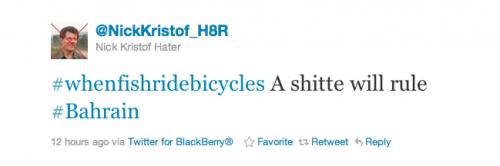
Nevertheless, some of the individuals on Twitter have also targeted Shi’a:
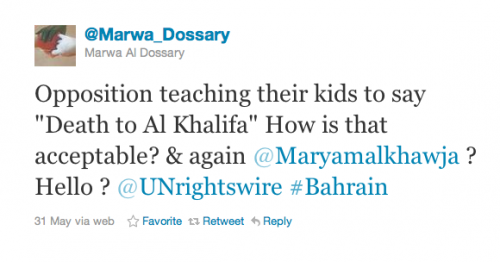
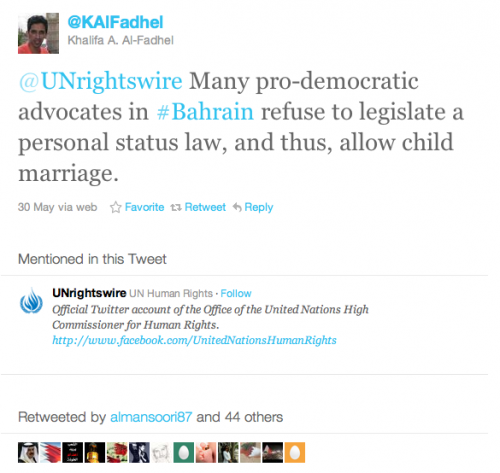
Others make extraordinary claims about what the opposition believes:
I had put the incident behind me until this morning when, at the IFEX (International Freedom of Expression eXchange) meeting I’m currently attending in Beirut, it was noted that Maryam Al Khawaja, who has been instrumental to Bahrain’s opposition, was meant to be speaking on the panel but couldn’t come. When I tweeted something a panelist said in her absence (Literally: “Panelist is now talking about #Bahrain, which has been “neglected and subject to a media blackout. #ifex11) I was once again bombarded, this time with insults slung at Maryam and her colleague Nabeel Rajab, who was detained and released in the past 24 hours.
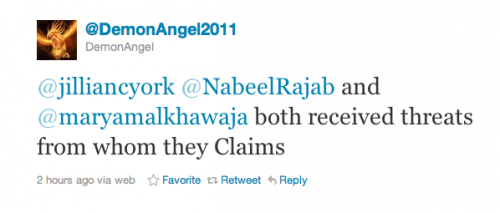
Scores of others have called the protesters “terrorists.” Many blame them for the violence handed out by the Bahraini authorities and invited Saudi military. They are disparaged, across online platforms, as having “ruined” Bahrain.
As I said, I cannot speak for Bahrain; I do not know whether it is better to protest in the street or to attempt dialogue, nor can I begin to make assumptions about what form of government should prevail. Mahmood Al-Yousif, one of the bloggers arrested last month whom I wrote about, has shared his thoughts on this, and I think that they’re reasonable. He writes:
But, danger is in the offing. If people take it into their heads to confront the regime one more time, if they needlessly attempt to go out and re-occupy the erstwhile Pearl Roundabout, then in all probability they will once again be met with force which might result in loss of life, injury or at best incarceration. The indications from online forums and Facebook pages suggests that some are determined to tread that path, folly as it is. For the sake of Bahrain, I hope cooler minds prevail, and a very much restricted and proportional use of force is employed, if required to restore the peace.
Whatever the outcomes, the truth remains: 29 are dead. Four died after being tortured in prison. Bloggers have been arrested, as have scores of doctors. While there are numerous ways to reconcile the country and come to a positive solution, the facts must not be swept under the rug. And no amount of propaganda on Twitter will silence the truth.
61 replies on “Tweeting #Bahrain: A Futile Effort”
many students fired from uni cause of facebook , tweets and blogs activities..
that’s y I’ve to close my mouth and say one person opposition write under threat , he is acting more than 100 ppl ..
Hello,
I’m trying to find any reliable source which indicates that Bahrain has a Shiite majority and a Sunni minority. Can you please send me the link of your source.
Thank you.
Good piece. One thing you must realise is that the ‘Human rights’ activists in Bahrain are actually sectarian politicians (i.e Maryam Al Khawaja ,Nabeel Rajab). This does not take away from the real need for reform,change and a more just society.
Non-partisans get really passionate when they see their businesses decimated by needless protests and jobs lost for no apparent cause. Also there is the real fear the Bahrain might go the Iraq,Libya or Yemen route,hence the aggressive nature of the ‘pro status quo camp’ add to that the religious undertone of the protests and you have real concerns about the end game or lack of thereof.
Bahrain has an unemployemnt rate of less than 5% and other positive human development indices,hence the frustration by moderate citizens (Shia & Sunni) that the extremists from both sides have taken over the fight for reform.
There is definitely many sides to any story and I wish you all the best as you do your bit.
Dear Jillian,
While I appreciate you trying not to meddle with the events taking place in Bahrain since -as you said- you don’t have the complete picture about the true nature of it, I disagree with some of the main points which you’ve stated in your piece. I shall try to address them here since 140 characters won’t do…
1. Sunni / Shi’a ratio or anything of such isn’t available to-date so calling one sect. majority over minority is baseless.
2. Re: Troops entering Bahraini border being Saudi, it’s in fact called “Peninsula Shiedl Force “PSF” http://j.mp/mrE7cU” which is simply put a joint-military task force by all GCC member countries similar to shall we say NATO. As per signed security & peace-keeping agreements the PSF would aid & assist any GCC country in times of need. And the violent protests which took place in Bahrain for a period of over a month called for such.
3. The roundabout monument, a symbol of 6 GCC countries united with a pearl on top was a tragic thing what happened to it but since before Feb14 events took place there was a plan to have a junction in the roundabout place in a move to ease off the traffic congestion in that area. So when the army came down & the roundabout area was shut down, it just felt like the perfect time to start the road works.
4. Many people in Bahrain “who are NOT hired PR or whatever some are calling us” joined twitter or old users such as myself started tweeting about the Feb14 events because of the one-side portrayal by protesters which the media & yours truly Nick Kristof has bought & decided that it was the 1 & only true image about what’s going on in Bahrain. True wrong actions have been made by both sides but how come very few cared enough to report about whatever was happening on the other side of the fence?
Many of us here in Bahrain supported the initial calls prior to Feb14 since they were demands that were shared by all, however on Feb17 our Crown Prince Sh. Salman has called for an end of protests & to start national dialogue between the opposition & the Govt. with no pre-conditions. His call was ignored by opposition & for over a month we have suffered the consequences of riots, daily protests, blocking of main roads & disruptions to our daily way of life. Added to the public university in the kingdom “University of Bahrain” has suffered around BD 2 million in damages due to the outbreak the took place there. Students got attacked, injured, limbs were cuts off & some now have to use a wheel chair for the rest of their lives. Not to mention the death casualties among police force who got run over by some of these protesters..
————-
Now after last night’s King’s Speech the State of National Safety has been lifted in the country & the national dialogue will start on Jul. 1, 2011 to reach an agreement that would satisfy all parties. Yes unfortunately few groups still call to go out in the street & protest instead of trying to reconcile & work towards building a better future for everyone..
Ok Mrs. Jillian , As am being featured in your blog without my approval. I feel compelled to set things straight , not for you as I did earlier but you still seem to think I was launching a harassment campaign against ; which is not true. Never the less for you readers, I would like to make it clear that pro-gov. Twitter users are not Khalifas or part of the government like you stated. That only adds to the fact that you are very well misinformed when it comes to the Make up of the Bahraini population , nor the political field . Please be more fair when addressing such issues In the future, well I can’t tell you what to do or try to change your mind, however please don’t shove me in your blog as I already apologized to you . That’s not very nice of you. Thanks
Marwa,
First off, your tweets are public. If you do not want your tweets to be public, you should enable the private tweet setting. You chose to launch a campaign that resulted in me being followed and continuously harassed by more than 150 Bahrainis who have no interest in what I say. As someone who monitors cyberattacks, censorship, and other related issues, your particular tactic–of harassing a Twitter user by encouraging numerous people to tweet at him/her at one time–is interesting and worth documenting for future reference.
-Jillian
Thanks for commenting Ali. I’ll try to address each point.
1. Point taken – I was basing that on “common knowledge” (e.g., what is commonly reported by mainstream media).
2. As I didn’t place a value judgment on the fact, I don’t see what the problem is. Given the amount of money my country provides to Saudi Arabia by way of military aid, however, I have every right to be concerned, particularly when people are killed at the hands of those forces.
3. Again, just stating fact. It was demolished, a fact which did upset many people who weren’t involved in the protests (from what I saw on Twitter and heard from friends in the country).
4. That’s not really my space. I haven’t been retweeting or interacting with Bahraini protesters on Twitter either, so I don’t know. As you know, I’ve written about Bahrain exactly twice: When @Mahmood was arrested, and when Emoodz was arrested. I occasionally retweet mainstream media articles or my good friend @justamira. That’s about the extent of my involvement; thus, the only reason I’ve written about this is because I was a target of insane harassment.
As I said, I think Mahmood’s blog post today was reasonable and expressed the sentiment of someone who clearly wishes for calm and peace in his country.
Mrs. Jillian first of all thanks for your reply but I would like to make it clear for everybody that I never had intentions to harass you by any means we were going to provide you of facts and evidence that some of the so called Bahraini or should I say Danish Human Rights activists like Maryam Al khawaja are very Sectarian and many Shiites in Bahrain despise her because of that. Secondly like Ali and others stated there is no official or Scientific Survey of Islamic Sects in Bahrain ; in this case the Sunni\Shiite ratio, many of the ones you find online are actually induced onto the web for years by the opposition, the UN never did nor accredit any of those surveys. Case in point Sunnis are not a minority in Bahrain, Sunni are not only Al khalifa , also not all Shiites are anti gov. . Let me make It clear however that we don’t have a Sunni\Shiite clash in Bahrain, we do have our political differences – generally speaking. That’s about it . And for the bloggers who were detained or questioned – none were tortured or put in jail. Same goes for @NabeelRajab who was called for questioning yesterday night and he himself tweeted that police officials were very nice and treated him with respect. Finally , please be balance , that’s all what we are as Bahrainis asking .
Ms Jillian,
I’m a resident of Bahrain and I can tell you that while your friend did actually report what was happening they failed to report both sides of the story or concentrated on one. I’m not a royal nor do am I part of the government or paid by it like some claim. I am just a person who has been living here all her life and although I do believe the protesters had a legitimate point and have the right to speak out the way they went about it was very wrong. Everyone is for reform and maybe a few changes in the government but most people started calling for the fall of the regime and death of the ruling family and the king, who has been nothing much supportive and lenient towards the people of Bahrain. I compare Bahrain to other countries and the citizens here enjoy all of it rights that other countries wouldn’t dream of. Freedom of speech is a right but they lost people’s support when they called for the death of the king, when they blocked the roads to the main city and wanted to halt the whole economy, attacked expatriates, naturalized citizens and prevented people from living their lives all the while claiming to be peaceful. They refuse to admit that there were wrong doings from their part, just like the government made mistakes. They stalled on holding dialogue although that was the only way to go forward AND HR acitivists failed to condemn the attacks on innocent expatriates. The country has laws that were not followed and yet the proptesters do not want to get punished for it all the while demanding the punishment of others.
Dear Jillian,
I appreciate you taking the time to write an article about our country and not trying to get too involved at the same time.
I agree with everything Ali Fareed said, excluding one point. The peninsula Shield did not come to Bahrain to stop protests or deal with protesters at all. They are here to protect Bahrain from foreign threat which in our case is Iran. They came to Bahrain through King Fahad causeway and went straight to the military camps and still remain there. They never even once interacted with protesters or any other non-military Bahraini citizens for that matter.
The only people who dealt directly with dispersing protest are policemen from the ministry of interiors.
I just want to clear one thing if you don’t mind, what Marwa Dosseri was trying to do is just to clear Bahrain’s image. It was not about the rumor that you were involved with the human rights website, everyone is entitled to have their opinion and so do you. She merely wanted to clear Bahrain’s name from the rumors and falsified information that was circulated through the media and social networks. I’m sure it was not her intention to harass you, as you saw she asked people to stop tweeting you when you tweeted that you were thought of it as harassment.
Pro-government people on twitter are not all from the royal family or working in the government as you mentioned. Just like the opposition have their views, others in Bahrain do too and tired of being counted as the silent voices. It hurts us to see false information being circulated about our country and it is our job as patriotic Bahrainis who care about this country to defend it. I’m sure you would do the same if it happens to your country.
I hope you never see dark days like our country did. We all thank god we’re out of it and back to our peaceful Bahrain. Its time for everyone to dialogue now and reach solutions instead of creating more chaos.
I’m very disappointed in you .you should have done your research before blogging this . you should have followed suit of Mr. James Clancy who actually came to Bahrain to collect information instead of basing everything on what he heard or what someone told him.otherwise you shouldn’t have blogged this baseless article at all . first you forgot to mention that the crown prince has asked the protesters to come to the dialogue table but they refused and continued to protest and close the streets . they killed two policeman a taxi driver and a prayer caller.the doctors you mentioned getting arrested refused to treat patients and was protesting outside the hospital. some of them even made some protesters wounds worse just so they can have something to deliver to the media. also the Troops entering Bahrain was in fact the Peninsula Shield Force . I’m a student at Bahrain university which was closed for two months after it was demolished by the protests . it’s only my first year and they totally ruined the experience for me . you say you don’t know much about Bahrain but i think that you actually don’t won’t to know . you have your mind set and you are refusing to listen to the other side of the story . this comment is for the benefit of your blog’s readers so they won’t fall into the protesters scheme as you did .
They just want to give you a clear idea of what’s going on because the international media does focus on the protesters more than the “pro-government” failing to realize that they’re more pf pro-regime. They recognize what the country has become because of the people and the regime. Yes reform is necessary but it doesn’t come in that way, they are acting illegally.
Dear Jillian,
I wanna know what would your government do when a group of people are protesting in an area where it will effect the economy and really bring it down as many companies in bahrain suffered major losses because people were to scared to go to work or leave their house.
These protestors also blocked roads to people’s working places and went on daily protesting rallies and in these rallies herassed citizens and in one case a woman was coming out of her work which is in the bahrain financial harbour and unfortunately she found herself in the middle of one of their protesting rallies and was herassed by them tell she accidently bumped into one of their so called “traffic organizers” which was not injured at all and later 4 men from the protestors attempted to attack her but luckily the a group of men from the city of busaiteen stopped them.
There was also the abduction of foreign workers in bahrain and being tortured and some also killed by these protestors where are human rights then or only protestor’s lives matter.
And there are many more acts of crime and violence. Ms Jillian if u weren’t trying to be one sided u could’ve tried harder by posting facts that protestors not that I’m saying all what u said and claimed to be the truth is really the truth
Thank you Ms. Jillian for your post,
I will not discuss the facts & figures about Bahrain as I’m sure you as a journalist would be able to source out accurate info.
The pro democracy (regarless of their sect) are tweeing, blogging and reaching our to International media/human rights organisations at their own risk. Any reaction they recieve is resulted in their arrest/detention/disappearance. Therefore, some stopped writing and some are writing under made up names to protect themselves (which isn’t helping the cause). At the same time, the pro government are encouraged by the government to electronic media scene and social media means. Addresses, emails and contacts are supplied by government officials to their public along with the messages to convey. This shows you how imbalance the situation is.
One of the characters created by the government to attack the opposition clearly & openly tweeted that they were in need of hackers and IT professionals and now tweets about how they can easily traces Facebook & twitter accounts and get their IP addresses & therefore identify their locations & send forces to arrest/threaten them.
Many of the detained were for reasons of writing comments online. and even more were laid off and suspended from jobs/universities/schools for the same reason.
Whether a person is pro government or pro democracy, I believe both should enjoy the same right of Freedom to the express their thoughts/opinions/feelings at least electronically!
Thank you for addressing this issue and I hope one day people will understand where it went wrong…
Dear madam,
I’m not going to talk like others, but rather I’d like you to watch each video and judge by you self , and see things with an open eye and mind about what really happened in my beloved country. Bahrain
This is a fact of the peaceful that terrorists was talking about in Bahrain
1. Indian official reply to Maryam Al Khawaja lies about Asian and expats in #Bahrain http://t.co/towpHg9”
2. Abusing Human Rights in Bahrain http://bit.ly/dR8TNz
3. Accusations by New York Times http://t.co/vOz3BVq
4. Human Rights (BCHR) Nabeel Rajab & Abdulhadi Al Khawaja, shehabi http://bit.ly/fdxi6Q
5. How I fled my attackers http://bit.ly/eG8QQ5
6. The Traitors – Terrorist plot in kingdom of Bahrain http://bit.ly/dGjFiV
7. hospitals staff & doctors demonstrating and blocking the hospital Emergency and Accidents doors http://bit.ly/hgUCHy and http://bit.ly/lreSp8
8. Doctors and nurses leaving their jobs and demonstrating http://bit.ly/iS8Qkv and http://bit.ly/mxgjgy
9. Bahrain major hospital (Al-Salmaniya) talk in Fox News htttp http://bit.ly/eAlHGP
10. Terrorists(anti-gov protestors)running over policemen in Bahrain him brutally http://bit.ly/eXQDS5
11. A witness tells the details of a policeman killed in Bahrain http://bit.ly/i91XYU
12. Even school girls are terrorist http://bit.ly/gR91mE
13. Party in the hospitals where the injured is http://bit.ly/eSaN2t
14. Report exposes the Shiite protesters in Bahrain http://bit.ly/l9AdKX
15. “Peaceful” protesters in Bahrain deal with an injured policeman http://bit.ly/jG0ENr
16. Molotov’s in the so called ‘peaceful protests’ http://bit.ly/hG2ImI
17. Bahrain protesters killing a police officer (Violent) http://bit.ly/fuUYLz
18. Terrorists in Bahrain cut an expact muazzin’s tongue http://bit.ly/lnhbEk
19. What happened in University of Bahrain http://bit.ly/iZUdAy
20. Terrorists attacking Pakistani residents in Bahrain http://bit.ly/hjm8VI
21. the truth about Bahrain protests http://bit.ly/iDPuH1
22. Salmaniya Medical Center http://bit.ly/l0BpXt
23. Bahrain Protest March http://bit.ly/dW9OCN
24. Shittes Terrorists drive over police in Bahrain http://bit.ly/kj04S4
Excuse the comments on the videos but this is because of the amount of suffering we have seen the past two months
Thank u
Hi Jillian,
Great article. I am familiar with Bahrain’s twitter ring and the overwhelming propaganda used against the pro-democracy protesters. I was also, at some point, part of the twitter discussion on Bahrain, especially with the active participation of VOA’s Cecily Hilleary, but I gave up at the end, because of the incredible offensive by pro-government folks.
I am a Sunni from Morocco. Here, we don’t have that sectarian divide like in Bahrain, but I am coming across a similar on-line offensive by pro-government activists (mostly paid for by the government, in my opinion) who seem to lift from the same rhetorical scripts used by their colleagues in Bahrain. They all wrap themselves in the national flag, hail the King, and describe the protesters as traitors and rogue elements.
If you have time, I suggest you pay some attention to what’s happening in Morocco., and if you like to stand by journalists, here’s a case which I think will grab your attention:
http://t.co/dGMjcr8
Jillian,
Thank you for the post. I have also been in a similar situation. My sources in Bahrain tell me the government is paying a lot of these people to harass, tweet, etc. If you want any solid sources inside of Bahrain, I can forward you their contact information (email me).
Keep up the good work,
Abbas
Sorry Jillian, the most of Bahraini democracy supporters can not leave their comment here because the Internet in Bahrain is strongly observed.
All what I can say on behalf of them is:
Thank you very much ♥
Dear jillian
here i may pointed one of the activiest that u may contact with, to get any infomation about what is going on in Bahrain.
http://twitter.com/#!/NABEELRAJAB
Thank you
I basically thank you
eventhough you dont have a sufficent information about Bahrain, you did speak out, thats exactly what we need, somebody to speak out and point to our country, im sure who ever glance over Bahrain will see how a peacfull protest been clashed with brutality of goverment.
we thank you very much
here reports too
http://www.nytimes.com/2011/06/01/opinion/01wed2.html?_r=2&scp=2&sq=Bahrain+&st=cse
http://www.heraldsun.com.au/news/world/men-raped-tortured-in-bahrain/story-e6frf7lf-1226067576811
It’s historical general knowledge. Why do u think the gov’t refuses to make a refurendum? Because they know Shiites are a majority!
you claim that you dont know much about bahrain but the terms you use are clear what message you are trying to deliver…
2nd point) you pointed out that four died as a direct result to torture in prison, you fail to provide a single shred of evidence.
i am not a regime loyalist as you describe me, searching for any ominous term to attract support from your readers. i am against the opposition, for they are sectarian revolutionist who seek to impose an islamic republic belonging to iran.
you have be realistic.
if you do not believe what the Khalifa Alfadhel tweeted read this
http://www.gulf-daily-news.com/NewsDetails.aspx?storyid=300172
nickkristof is a blatant liar, working for NTYimes, the same newspaper that spread lies leading to an Iraqi Holaucast leaving more then a Million Iraqi dead!! enough said about it
would you blame people to label them terrorist? what would you call people who intentionally crash into policemen? i remember not long ago the royals in Holland were parading around and a lone car crashed into them.. the first thing the police said was that it wasnt a terrorist! probably a drunk man ..
i can continue on and on and on..
im telling you very honestly .. one thing that unites Bahrain is that they are anti-opposition.. ask yourself why?
didnt you see what these sectarian revolutionist turned iran into? turned Iraq into.. how they are destroying lebanon.. now you want us to hand them our own beloved loving peaceful kingdom
This is so COOL .. THANK YOU JILLIAN
=)
Yet again many here are claiming we are being paid by the govt.. thats very insulting. a guy from morroco is probably guessing too.. this shows that people are basing their judgement on emotions rather than facts.. i bring you facts you bring me emotions..
how can people claim to be “pro-democracy” when fail to share the most simple and basic values of democracy.. working with other minorities and groups. as soon we we provide a different side of the story we are accused of being paid by the “monarch” thugs, etc.
i read a comment asking you how would your gov react to such protest harming the economy..
then i remember your govt are responsible for many wars.. whether your british or american.
remember these groups called on students teachers nurses doctors to strike!
yet they failed to bring the country to a halt… so they went and used other measure blocking streets.. sending people back .. its like they wanted to force their strike on us.. again seems like someone needs to educate these pro-democracy fellows on democracy..
reply at Ibrahim comment :
LOOOOOOOOOOOL
now look who’s talking , nickkristof is a blatant liar !! ok
what about :
– doctors without borders international org
– reporters without borders international org
– obama
– cnn channel
– frontline international org
– Human Rights Watch
– BBC
– LAtimes
– iRish times
– The Independent
– The Guardian
and so many other magazines and organisations
>>
just be reliable for once
True, many have been arrested merely for tweeting. @emoodz is an example. The interenet is closely monitored and anyone posts anything anti-gov is risking detention and torture and possible rape in the infamous Bahraini prisons.
these are thugs who u call regime loyalists are spreding lies
and most of them are from saudi arabia who genraly hate shiaa
and the GCC force are ment for outside danger not for an inside revolution
thats what the Secretary of State now the amir of kuwait said 27 years ago
http://www.youtube.com/watch?v=9qCo_FiViGI
AND about the national dialogue!
is the king think us stupid!!
the main reasons for the revolution is the prime minister
hes been sitting on his chair for 41 year old
from the day of bahrain independent till now!!!
and the king want us to dialogue with this blood sucking monster
And F Y I today the government fired at us protesters bird shot,tear Gas.
and some live handgun Bullets
and the army is still in the street
is this the dialogue the king wants?
———————————–
sana
today one of the U S A embassy women said in BTV
Shia are majority in Bahrain thats a history fact and general information
————————————-
max
hope u get u demands
and theres no sectarian divide the government is trying to make it like that
————————————
AAlmail
first
from day one we didnt call for the fall of the regime
after 7 people die we call for that
and gets your facts right
we didnt stalled
we waited 10 years to dialogue with them
and we thank the crown prince and he agree for our terms
the that prime minister call for saudi army -GCC-
because of 1 of our terms was to step down
other thing u say or the other are simply lies
thnks Jillian
i hope u get a cleat point in what happing in bahrain
and hope u came to watch us because we are stil protesting
so u know that we are peaceful
by the way 4 people died in jail-tortured-
Thank you
The simplest question is where is the global media about what happening in Bahrain? One simply can not talk openly about abuses against peaceful demonstrators, in the name of humanity, defended these people who killed and tortured every day
Ok, a word of advice, not all Bahrainis that support the government are either from the royal family or being paid by them. This is just bullshit. Sorry for saying that but I couldn’t find a better way to put it. If you’re planning on meddling in the issues of my country, I atleast expect you to hear from both sides of the story and not get into conclusions by hearing from a bunch of secterian bloggers or sources. What Marwa did was not targeting you by any means, not trying to harass you or any other tweeps but to make her voice heard. Actually not only her’s but the majority of Bahrainis or Sunnis whom the western media have chosen to ignore. Did you ask yourself the following questions before insulting us or believing the so called “Pro-democracy” “Peaceful” protestors:
Why are most of them Shia? What’s the motive behind their protests and terror throughout the 30 past years? Look at the history and not just the past three months. Ask them why do they obey whatever Khamena’ee orders them to do? Why do they admire hezboallah and Hassan Nasr Allah? Why do they have pics and posters of Iranian figures everywhere at their homes, cars, offices, etc? The fact that 99.9% atleast of the Sunni Sect is against those protests should atleast get you suspicious doesn’t it? Did you try to google “Bahrain is Iran’s 14th province”? Do it and look for the results you get Mrs.
The bottom line, They want Bahrain to be the next Iraq + Lebanon, to be ruled by Iran.
I honestly don’t know what these people are protesting for i honestly dont think they have a good reason to demand that the government would step down, these people are ungreatful people they have no idea how good they have it, we have great educational options it is so easy to get a great education, we have free public schools in every area the university of bahrain offers and education of BD 24 per subject ($63.65) which is so cheap for what is the best university in bahrain and most probably in the GCC and they get all types of scholarships from the ministry of education and the crowned prince scholarship and many more. The price of our petrol is cheap compared to other countries it costs BD 1 per 10 litres ($2.65) and most importantly there is nooo taxes. Our unemployment is just around 3% and the ministry of interior just issued 10000-30000 jobs (I’m sorry my memory is kinda fuzzy) and this isn’t even half of it, what more do they want I’m not saying bahrain is the richest country or that there are no poor people in bahrain but there are poor people everywhere and I would love for this country to not have them and every could have a great life and be happy but this isn’t a fairy tale.
And a final word to these people that say that we are paid to say all of this just because we aren’t against the king and the government doesn’t mean we are paid for and I think the national unity assembly speaks for itself ;)!
Hello every one,,
Special hello to the person who gave chance to demolishe the lies on this page, Jillian.
In simple words, not complecated thoughts,
If the protesters were a lie,
if the revelution was an outside agenda,
if the people of bahrain were bloody and killed the policemen
if the peace talk that the P.M. talked about was true,
if the GCC forces were only to protect the buildings,
if …
if…
One single question mark appear on top of my head,,
Why did the king forbid the news agencies and reporters from entering Bahrain and refused to allow the health support team that was sent from Kuwait to enter the country when he accepted the GCC forces to enter !!!!!
Thank you all who still have minds to think and realize.
And forgive me stuborn, I am not talking to you.
national unity assembly
u didnt know that the boss of this assembly received 7-9 million?
all your words are nothing
because our demand were political
and you talks about the demands that your- national unity assembly- raised
your the one that more money?
we want to stop sectarian discrimination
we want to be involved in political
we want real parlement not fake
and we demand that the government would step down because this government
is the responsible for my brothers deaths and blood bath
To anyone seeking answers to the questions ar_dashti is posing,
Maybe these measures the government has taken is a result of the campaign of complete and utter misinformation some of the pro-democracy supporters successfully carried out.
You “human rights activists” who are so clearly politically inclined, otherwise why have they not once mentioned the injuries and deaths of people who fell in the hands of rioting protestors? While human rights activists would seek out political tools to ensure that rights will be realized, what we see with these supposed ‘human rights activists” like Maryam AlKhawaja and Nabeel Rajab are the complete opposite. They are driven not by the hope of the attainment of universal human rights, but they are driven by a political agenda deeply embedded in Bahraini history (look at Wikileaks documents for just a small example) and these whole guise of human rights is a tool they are using to realize this agenda.
Many international news reporters that were coming into Bahrain were invited and guided by members of the opposition, so by default their reports were biased and slanted.When these reports were broadcast, and thanks to the laziness plaguing journalism today in which it seems as though no fact-checking is required and all that is needed are anecdotes, journalists seem to have stubbornly imbedded a certain image in their minds of Bahrain. Unfortunately, this image a false, misinformed and dangerous one has holding onto it without any legitimate facts in support of it is further perpetrating the disintegration of our country.
Please note that I have no affiliation with the government and that I was initially a supporter of the movement because I did believe some reforms needed to be made. Unfortunately, I realized over time by personally seeking out the truth, that my support was misguided. I am a supporter of the idea of reform, but in no way am I a supporter of the radical, illegal and treacherous ways this reform is attempting to be realized. Especially when ‘reform’ and ‘democracy’ seem to just be pseudonyms blanketing the real type of government the radicals of the opposition want, which is a theological republic that by default is discriminatory.
Finally, I would like for there to be a distinction between the pro-democracy supporters who carried themselves in a legal and respectful manner, who genuinely were seeking reforms, and the ‘pro-democracy’ protestors turned rioters who have infiltrated the foundations of our country and tarnished them.
ar_dashti and anyone seeking answers to his questions,
Maybe these measures the government has taken is a result of the campaign of complete and utter misinformation some of the pro-democracy supporters successfully carried out.
You “human rights activists” who are so clearly politically inclined, otherwise why have they not once mentioned the injuries and deaths of people who fell in the hands of rioting protestors? While human rights activists would seek out political tools to ensure that rights will be realized, what we see with these supposed ‘human rights activists” like Maryam AlKhawaja and Nabeel Rajab are the complete opposite. They are driven not by the hope of the attainment of universal human rights, but they are driven by a political agenda deeply embedded in Bahraini history (look at Wikileaks documents for just a small example) and these whole guise of human rights is a tool they are using to realize this agenda.
Many international news reporters that were coming into Bahrain were invited and guided by members of the opposition, so by default their reports were biased and slanted.When these reports were broadcast, and thanks to the laziness plaguing journalism today in which it seems as though no fact-checking is required and all that is needed are anecdotes, journalists seem to have stubbornly imbedded a certain image in their minds of Bahrain. Unfortunately, this image a false, misinformed and dangerous one has holding onto it without any legitimate facts in support of it is further perpetrating the disintegration of our country.
Please note that I have no affiliation with the government and that I was initially a supporter of the movement because I did believe some reforms needed to be made. Unfortunately, I realized over time by personally seeking out the truth, that my support was misguided. I am a supporter of the idea of reform, but in no way am I a supporter of the radical, illegal and treacherous ways this reform is attempting to be realized. Especially when ‘reform’ and ‘democracy’ seem to just be pseudonyms blanketing the real type of government the radicals of the opposition want, which is a theological republic that by default is discriminatory.
Finally, I would like for there to be a distinction between the pro-democracy supporters who carried themselves in a legal and respectful manner, who genuinely were seeking reforms, and the ‘pro-democracy’ protestors turned rioters who have infiltrated the foundations of our country and tarnished them.
I apologize for the error in:
‘You “human rights activists” who are so clearly politically inclined, otherwise why have they not once mentioned the injuries and deaths of people who fell in the hands of rioting protestors?’
It should read:
‘These “human rights activists” in Bahrain are so clearly politically inclined, otherwise …etc..’
One need not be an expert on the minutiae of Bahraini politics and demographics to understand a simple fact: a group of people that were peacefully voicing dissent and petitioning their government in support of reforming that government to be more representative and more free were met with violence. One need not be an expert on the minutiae of Bahraini politics and demographics to understand that the arrest, detention and torture of accredited journalists is a crime. One need not be an expert on the minutiae of Bahraini politics and demographics to understand that the cited justification activation of the GCC Shield Force–which brought Saudi and UAE troops across the Causeway– is complete rubbish; that Iran posed no greater existential threat to the Island because of the Pearl Roundabout protests.
Lastly, one need not be an expert on the minutiae of Bahraini politics and demographics to understand that because the underlying circumstances that led to the Pearl protests have not been addressed, the Government is not only kicking the can down the road, they have deepened the hole and further entrenched their opponents.
Dear Ms. York,
First let me apologize for the cyber-harassment you received. I think this is such an emotional issue for those of us living in Bahrain and many have felt betrayed by the international media. However, it is just as wrong to place all journalists in the same basket as it is to do to the Shi’a, Sunni or expats living in Bahrain, as well as pro-government or anti-government tweeps.
It is unfortunate that so few people living outside of the GCC really understand the issues here and the concern over Iran’s interference in the Arabian Peninsula. That said, it is critical that the Gulf countries be more proactive about getting their message out so that people like you can consider opposing views more critically. As for the media getting a better handle on all sides in Bahrain, I hope that the government will be more proactive in keeping the international media better informed and believe that is in the works.
Best Regards.
You can find the Sunni / Shi’a ratio in the U.S department of state page about Bahrain
http://www.state.gov/r/pa/ei/bgn/26414.htm
Religions: 98% Muslim (approximately Shi’a 70%, Sunni 30%), with small Christian, Jewish, Baha’i, and Hindu communities
LOL … So the US knows about our country more than the Bahraini Government and us! Hahahaha
I support the government and I haven’t been paid a penny! Why don’t you guys prove in anyway that we are being paid?!
In fact people from the USA who interfere in the Bahraini issue have never and would never answer questions assuming that the same situation happens in their own country.
It’s obvious that the Bahraini regime has a wealth of online supporters. Paid or unpaid, they are spreading lies and harassing online activity of ordinary Bahraini citizens. Yes friends, you continue to denie that a large external force was called into Bahrain to put down the popular voice. That Bahrainis are calling for freedom and in return the vicious response resonates from shotgun barrels and grenade launchers. That four detainees were returned mauled to death by security service interrogators who are most likely from Pakistan.
If there are no official numbers on demographics in Bahrain, and noone has anything to be afraid of, then why such a harsh response? The truth is, the Bahraini government only has to fear its own actions, which are leading the country down a dark and unknown path. There is only one solution, the one that these twitter harassers are intent on denying. The people deserve to be heard, and it is imperative that they be allowed to have a voice.
This is an ill crafted attempt to once again foil the majority’s calls for basic rights.
Why government loyalists keep reminding us in every comment/ reply they post that they are not paid? Two possibilities:
a. They are paid and they feel that another lie will not do them harm (since their comments are basically a sea of lies and baseless claims anyway).
b. They are not paid, but they want to disassociate themselves from the government, since no sensible person in this world wants to be associated with an entity with such a bad name. ( this is like saying:”I am raping you but I am not part of the gang!”).
I honestly fail to understand how these armatures expect the international media to take their side of the story against the much documented and credible materials produced by organizations such as the Nobel prize winners, Physicians for Human Rights, Amnesty International, Human Rights Watch, Human Rights First .. and tens of reputable reporters and bloggers.
Dear,
who told you that in Bahrain we have sectarian divide?
they do pay? didnt know that! please tell me so i can go get my self some cash plz
do you know that DWB, RWB, HRW are surviving on donations? and they are not under UN?
and why didnt they report noth sides of the story? bieng one sided always indicate that your reports are not crediable. since UN rule for thos NGOs is that thier reports should be balanced they should interview goverment and non-goverment orgs. which they didnt. read more dear it more useful to you :)
hahahahahahahah, saudiss!! nw we became saudies omg. first you called us baltajiy, nw saudi whats next? plz tell me
thank you jillian,
i am sorry that you consider the tweets as harassment, since those people were just trying to deliver the truth to you. those who have been living in fear and under threat by the so called “pro-democracy or peaceful” protesters.
in Bahrain we all wish for reform, but we need to demand it in the right way. we are against the protesters because of their sectarian and violence acts toward all the people in Bahrain.
and i wish you base your words on true and trusted info. since “general info.” with no credible source is not considered as info. you may use in a public article.
if Nick was not bias no one will be against him, reporting only from one side is not a right way. today his article mentioned king Khalifa!! who’s king Khalifa by the way? isnt that proof that his work is copy”n”past, sorry but this is really shows that his article are being outsourced to him.
unfortunately, HRW, DWB, and others fail to show the truth about Bahrain. since they depend only on one resource which is BCHR, which controlled by one family only! khawajas and their son in law Nabeel rajab. and its not a legal center btw.
when 400,000 people gathered against the protesters you and nick failed to report it.
i am sad that i see people trying to destroy their country and they name it peaceful protests, sad to see them publishing lies just to destroy their country image.
i hope you realize the situation here in Bahrain. thanking you for not meddling here, and we wish f you think to do so don’t be bias and get the information from a good source not “general info.”
thanks
If there is “misinformation”, isn’t letting reporters enter Bahrain and report the truth for themselves seems the logical thing to do? Unless the gov’t has something to hide which is the case now as the bloody crackdown is still going on.
Totally agree!
dear Jillian , there was no regime as brutal as saddam of iraq who used chemical weapons against its own people and still he had people defending him so it is not a surprise that this regime of bahrain has supporters too. I frimly believe that those progovernment individuals are worse than the dictator himself bec the latter at least is defending the power and wealth! How can this dictator and its supporters justify the jailing of doctors/nurses and even patients , how can they justify the jailing of a young poet (Ayat al qormerzi). DO this dictator really thinks that these innocent protestors will give up ? really after all the killings/torture/rape ? Mr Nabeel rajab is the voice of the oppressed and the regime is so afraid of this one voice leaving bahrain not for lack of trying of course. I know that my voice count and this is why I post my openion as it is the least that I can do . God bless you .
Dear Jillian,
a big thanks goes to you..its overwhelming and sad at the same time to see people from the other part of the world feeling for bahraini ppl more than its own..
a small messgae to the ant-gov comments out there,, the world is not looking at your side because they have opened their eyes to things you dont wanna open your eyes too…
the govt has accused all the channels in the world with words like liars, betrayers etc and its only believing its blind channel which they are controlling the way they want.
Jillian, once more thanks for seeing what some people of this country cant see.or in other words dont want to see
correction: the message goes to pro government
Jillian,
I hope by now you can see the reasons why we (not paid by the government) are opposing the protests. And I hope you can find a neutral Arabic speaking person to translate the directions given to protestors in this link
http://www.youtube.com/watch?v=5M0fSZMbVo8&feature=related
or this one
http://www.youtube.com/watch?v=zlPTELIZvGI&feature=related
Facts on the Ground: A Reliable Estimate of Bahrain’s Sunni-Shi’i Balance, and Evidence of Demographic Engineering:
http://bahrainipolitics.blogspot.com/2011/04/facts-on-ground-reliable-estimate-of.html
As a Bahraini (Shiite, and I don’t like to use this word. As I said I’m Bahraini) we want Justice. That’s it.
Thanks Layla, but my Arabic is just fine.
[…] the twitter counterrevolution in Bahrain, Jillian York: Last weekend, I became the latest victim of the Bahraini Twitter war after I came across some […]
“..no amount of propaganda… will silence the truth.” I agree with you. The Bahraini government especially the king should act appropriately for the sake of his people and his country. Many have already died. How many more people should die before a solution will be initiated? How about Bahrain’s reputation in the international community? There is so much at stake here.
[…] is targeted, then shortly thereafter receives an apology from her persecutor. I’ve had similar situations, in which the trolls have actually attempted to engage in diplomacy, using fairly reasonable […]
[…] is targeted, then shortly thereafter receives an apology from her persecutor. I’ve had similar situations, in which the trolls have actually attempted to engage in diplomacy, using fairly reasonable […]
[…] is targeted, then shortly thereafter receives an apology from her persecutor. I’ve had similar situations, in which the trolls have actually attempted to engage in diplomacy, using fairly reasonable […]